
产业
L’Oréal: The Long-Termist
On April 27, 2026, in the Rose Ballroom of The Peninsula Shanghai, L’Oréal China held a strategic communication meeting under the theme “CreAIte the Beauty that Moves the World.” In an ordinary year, this might have appeared to be just another important annual event for a multinational company. Yet when the details are laid out—the company’s No. 1 market share, its mid-to-high single-digit growth in the first quarter, the design of three thematic forums, and the joint launch with Huashan Hospital of La Roche-Posay’s supramolecular innovation and 2026 For Girls in Science Empowerment Program Kick-off—it becomes clear that beneath L’Oréal China’s seemingly steady narrative lies a much more far-reaching vision. It is advancing each step today with a future-oriented, long-term mindset.
Performance is the most visible evidence. In 2025, L’Oréal China maintained its leading position in the beauty market. In the first quarter of 2026, it continued to achieve mid-to-high single-digit growth, outpacing the broader market recovery. Its four divisions have formed a structure in which each occupies a clear position while generating synergy: L’Oréal Luxe leads its segment with around 30% market share; the Dermatological Beauty Division recorded 19% growth, with SkinCeuticals firmly ranking at the top of its field; the Consumer Products Division and the Professional Products Division also maintained leadership in their respective arenas. Online, L’Oréal ranks No. 1 across all e-commerce platforms, including Tmall, JD, and Douyin; offline, the Consumer Products, Luxe and Dermatological Beauty divisions opened more than 150 new stores in the past year alone. The Consumer Products Division’s brand network now covers more than 1,700 cities, spanning all tiers. Taken together, these figures outline a company that continues to move forward with stability and confidence despite macroeconomic pressures.
But if one asks why L’Oréal has become the world’s leading beauty company, scale and channels alone are clearly not enough. What truly sets L’Oréal apart from its peers may be its ability, in every new era, to root itself deeply in two fundamental dimensions: the underlying logic of science and the profound needs of people.
First, science. One of the key launches at this meeting was La Roche-Posay’s supramolecular oil-control and balancing skincare series. This is not merely another new product, but the first co-created outcome of the industry-academia-research-medical collaboration between L’Oréal and the Dermatological Beauty Divisions at Huashan Hospital. Behind terms such as “dual-complex supramolecular technology” and the “9:8:5 golden ratio of three acids” lies a deep accumulation of L’Oréal’s local R&I capabilities in China. In other words, L’Oréal does not view its China research center merely as a localization window for overseas technologies; it has built it into one of the sources of innovation for the Group globally. Its Suzhou plant has been operating for three decades and is now the Group’s largest production base worldwide. Its Nantong intelligent operations center is scheduled to break ground in the second half of the year. Continued investment in these asset-heavy areas—R&I, manufacturing and operations—forms a moat that distinguishes L’Oréal from asset-light, internet-famous beauty brands.
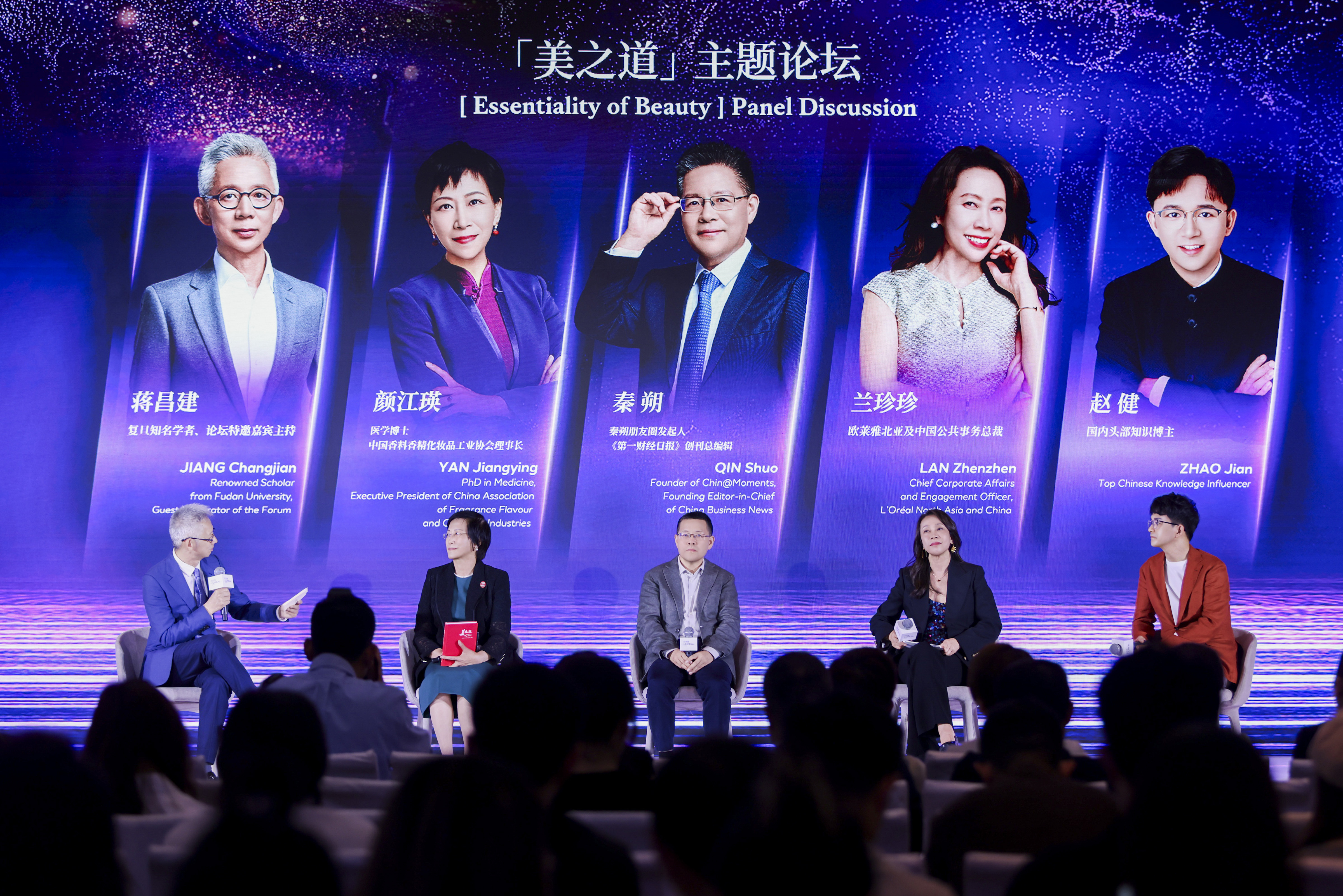
Then comes AI. While many companies are still debating whether AI will disrupt the industry, L’Oréal has already put forward the idea of “AI for Beauty” and, for the first time, created a dedicated forum on this theme at its strategic communication meeting. Participants included Rachel Huang, Chief Growth Officer of L'Oréal North Asia and China, and General Manager of L'Oréal Buycoor, Yuri, an AI-native virtual idol, scholar Jiang Changjian, and tech-KOL Pan Luan—a dialogue that even crossed the boundary between human and virtual beings. At the subsequent “The Essentiality of Beauty” forum, Yan Jiangying, Chairwoman of the China Association of Fragrance, Flavor and Cosmetics Industries (CAFFCI) and a medical doctor; Qin Shuo, renowned media figure and founder of Qin Shuo’s Moments; and Lan Zhenzhen, Chief Corporate Affairs and Engagement Officer for L'Oreal North Asia & China, among other distinguished guests, shared their insights on “AI for Beauty” and the broader meaning of beauty.
As Yan Jiangying noted, in the age of AI, we need technology to be guided by good, and we need to define authentic beauty. For China’s beauty industry, it is important to embrace AI, use AI and pursue AI for science. But AI cannot become the “brain” of a brand, because AI cannot calculate the “soul” of a brand. The authenticity and originality of beauty matter more than ever. Truth and originality will always be the most moving essence of beauty. In the future, the scarcest resource will not be computing power, but humanity with warmth, personality and a unique perspective. Through its own “Essentiality of Beauty,” L’Oréal is precisely practicing its values and creating far-reaching impact across society, the economy and culture—especially through its attention to, and investment in, people.
It is worth noting that embracing technology alone is not enough to explain L’Oréal’s resilience. The real key is that L’Oréal has never lost sight of people amid the roar of technological change. At this communication meeting, the company announced the “For Girls in Science” Empowerment Program, through which it will donate RMB 10 million over five years to build an intergenerational empowerment chain connecting women scientists, young women in science and technology, and girls in secondary schools with an interest in science. This continues L’Oréal’s long-standing commitment to women’s empowerment. At the same time, initiatives such as “Beauty for a Better Life” public welfare training, “Youth Fun” campus charity sales, beauty tech hackathons and the BRANDSTORM youth innovation competition have empowered more than 360,000 young people. L’Oréal is not only selling products; it is systematically investing in people—especially those who have not yet been fully seen at the intersection of technology and beauty.
This touches the very essence of why L’Oréal is L’Oréal: it has always understood beauty as an ecosystem, not a production line. In this system, science is the soil, technology is the tool, and people are the purpose. When Vincent Boinay, President of L’Oréal North Asia Zone and CEO of L’Oréal China, said that “Investing in China is investing in the future of beauty ,” this was not a slogan, but a judgment grounded in reality. According to data previously released by CAFFCI, China’s beauty market has exceeded RMB 1 trillion for three consecutive years and remains the world’s largest beauty market. At the same time, the complexity and diversity of demand in the Chinese market are forcing—and nurturing—a new paradigm for the development of beauty.
From value-for-money to value-for-mind and value-for-emotion; from mass-market products to high-end customization; from offline stores to omnichannel touchpoints, consumer demand is no longer a single line, but an intricate web. L’Oréal is using a brand portfolio that spans all categories and price tiers to respond to this web. It uses highly differentiated brand personalities to resonate with different consumer emotions, and then refines every touchpoint through AI, professional offline channels and other tools.
Ma Xiaoyu, Deputy CEO of L’Oréal China and General Manager of L’Oréal Luxe China, put it well: the industry needs to “return to the essence of beauty, return to people’s real needs, and return to long-termism in brand, experience and value.” These three returns are precisely among the rarest qualities in today’s impatient business environment. L’Oréal’s long-termism is not empty talk. It is reflected in the continuous upgrading of its Suzhou plant over three decades; in its steady presence in China for 29 years since entering the market in 1997; and in its calm posture toward the AI wave—neither standing still nor blindly following the trend.
Overall, the three thematic forums of this communication meeting—“AI for Beauty,” “The Essentiality of Beauty” and “Consumer Centricity”—correspond exactly to the three dimensions through which L’Oréal understands itself: technology, humanity and the market. These three are not separate from one another, but intertwined and mutually reinforcing. “AI for Beauty” addresses efficiency and boundaries; “The Essentiality of Beauty” answers questions of value and direction; and “Consumer Centricity” ensures that all efforts are ultimately calibrated toward the people they are meant to serve.
Perhaps L’Oréal’s true secret lies in its “scholar-like patience”—a long-term way of thinking. It is not shaken by short-term market fluctuations, nor is it swept away by any single technological narrative. It is willing to spend years co-developing a product with professional institutions, while also having the courage to establish a cross-species dialogue forum at the early stage of the AI wave. This patience is not sluggishness, but reverence for the ancient proposition of beauty. Beauty has never been something that can be made overnight. It requires the support of science, the catalyst of technology, the sedimentation of time, and a deep understanding of human nature.
When L’Oréal announced that it would continue to increase investment in China across R&I, technology, operations and the broader ecosystem, it was in fact placing another long-term bet: beauty is ultimately an industry for optimists. Because it believes that people will always aspire to a better life; that technology can make that aspiration more tangible; and that beauty can be passed between generations and flow between science and the humanities, L’Oréal has the confidence to write the words “CREAITE THE BEAUTY THAT MOVES THE WORLD ” with such conviction at its strategic communication meeting.
In truth, L’Oréal has always been walking on the road toward the future, and it has never left the stage. To truly observe L’Oréal, we cannot look only at the surface of the present moment. We need to place it within the long river of history. To understand how L’Oréal has remained increasingly vibrant across 117 years, we cannot focus only on this strategic communication meeting, brilliant though it may be. We need to pull the lens back, place the company on a century-long timeline, and then slowly zoom in. What emerges is an almost persistent habit: at every seemingly stable moment, L’Oréal is already laying the groundwork for the next decade, or even the next thirty years. This long-term thinking is not a slogan written in a PowerPoint deck; it is an instinct embedded in its operating DNA.
More than a century ago, L’Oréal’s founder, Eugène Schueller, did something rather unusual for his time. He not only invented the first modern hair dye, but also established a research laboratory. Today, this may seem natural. But at a time when cosmetics still largely belonged to the world of artisanal workshops, a haircare company investing in basic research was like digging a canal in the desert. Yet it was precisely this “canal” that enabled L’Oréal, in the decades that followed, to launch era-defining products in sun care, skincare, active health and beyond. Before each technological wave arrived, L’Oréal had already prepared its vessel on the shore.
Consider the 1980s and 1990s. While most cosmetics companies were still relying on a single brand to conquer the market, L’Oréal had already begun systematically building a brand portfolio. It acquired premium brands such as Lancôme and Helena Rubinstein, introduced dermatological brands such as La Roche-Posay and Vichy, and retained L’Oréal Paris for the mass market. This full-spectrum layout was once considered overly complex, even aggressive. But looking back today, it is precisely this array that has allowed L’Oréal to withstand fluctuations in any consumer cycle. When the premium market cools, the mass market can compensate; when skincare slows, makeup and fragrance can step in. The fundamental reason why L’Oréal China was able to remain No. 1 in 2025, with all four divisions working in synergy, lies not only in what it did that year, but in a strategic design and long-term commitment that began decades earlier.
Entering the 21st century, L’Oréal made another decision that was not fully understood at the time: to fully embrace digitalization and the Chinese market. Around 2000, when China’s beauty market was still in an early and rough stage of development, L’Oréal established a research center in Shanghai. Around 2010, before e-commerce became a mainstream channel, it had already begun to build its online presence. By the time the concept of beauty tech gained momentum in 2018, L’Oréal had already laid out a full-chain digital infrastructure. The “AI for Beauty” proposition put forward at this communication meeting is not an opportunistic response to the current trend, but a natural extension of this long-term trajectory. In other words, each of L’Oréal’s forward-looking moves may, at the time, look like a move that produces no immediate effect or even lacks certainty. But years later, those seemingly idle moves often turn out to have landed exactly where they were needed.
Behind this long-term thinking is an extremely clear self-understanding: the essence of the beauty industry is neither simply consumer goods manufacturing nor pure emotional marketing, but repeated dialogues between technology and the humanities on the skin. In Yan Jiangying’s words, it is about “the stories in the wrinkles of the skin.” Technological breakthroughs require investment measured in decades; humanistic accumulation requires cultivation across generations. One fundamental reason L’Oréal is L’Oréal is that it has always pursued those slow but irreversible tectonic shifts: changes in demographics, the evolution of consumer values and the transformation of technological paradigms. When it says it will increase investment in China, it is not investing in sales for the next quarter, but in the mindset and lifestyle of Chinese consumers over the next decade. The Nantong intelligent operations center, the BIG BANG Beauty Tech Innovation Program and the For Girls in Science empowerment program announced at this meeting all clearly reflect this “ahead-of-the-cycle” approach. These actions may not show immediate results in next year’s financial statements, but in five or ten years they will form part of L’Oréal’s competitive moat.
This naturally leads to another question: for domestic Chinese beauty brands that are striving hard and have already risen in the Chinese market, what inspiration can L’Oréal’s long-term thinking offer? There may be many lessons—brand building, scientific research, product portfolios, channel balance and more. But in my view, at least one lesson is essential, and should perhaps be placed at the top of the priority list: investing in the social value of beauty. In China alone, L’Oréal has done many things that appear unrelated to sales, such as empowering girls in science and technology, supporting youth entrepreneurship, and promoting sustainable refill solutions. These efforts cannot be directly converted into GMV, but together they shape the social roots of a brand.
When consumers make decisions among countless choices, this long-accumulated trust and goodwill often become the final deciding factor. Domestic beauty brands have never been stingy when it comes to traffic spending, but they often invest too little in this kind of “slow public relations” and “long-term public welfare.” This is not merely a matter of corporate social responsibility. It is the deep cultivation of brand equity and the creation of social value as an industry leader. It is no exaggeration to say that this is the root of value and the source of tension for an entire industry.
Of course, L’Oréal is not perfect. At times, it may not respond quickly enough to certain market changes; in some emerging trends, it may occasionally lag behind local rising brands; and sometimes it may even carry a certain pride deep in its bones. Yet its long-term thinking gives it room to correct mistakes and capital to recover. A product misstep or a marketing setback may be fatal for a brand without depth. For L’Oréal, it is only a small footnote in a much longer narrative. This resilience is not built by burning capital. It grows from roots cultivated consistently for more than a century.
Returning to this communication meeting, Vincent Boinay’s statement that “Investing in China is investing in the future of beauty ” takes on deeper meaning when placed within L’Oréal’s century-long coordinates. L’Oréal once helped create the modern paradigm of beauty in France, the mass-market paradigm of beauty in the United States, and the refined paradigm of beauty in Japan. Today, it is further deepening its presence in the Chinese market. This reflects both the importance it attaches to China and the latest expression of L’Oréal’s long-term thinking. Once again, before the tide has fully risen, it is standing at the very front of the shore.
For domestic Chinese beauty brands, rather than becoming anxious over immediate market share battles, it may be more meaningful to sit down and ask: in ten or twenty years, what kind of tree do we want our brands to become? Are we planting fast-growing poplars, or oaks that can stand for a century? The answer may lie in every choice we make today.
At least one thing is beyond doubt: in a world chasing the next trend, L’Oréal will always choose to follow the tectonic movements deep beneath the surface—because those are the forces that truly reshape the landscape.
2026年04月30日 09:59

京公网安备11010502058609号